
Acoustic Office Pods & Speech Privacy Evidence
Understand how ONMUSE office pods support speech privacy for B2B office projects, open offices, meeting areas, and project spaces — with acoustic evidence explained under tested conditions.
Office pods are not total-silence rooms. They are designed to give users a more private place for calls, video meetings, one-on-one conversations, and focused discussions compared with speaking at an open desk.
Review speech privacy and acoustic evidence before requesting support for your office pod project.
Request Acoustic EvidenceRequest Project Acoustic ReviewTalk to Project Team About Speech Privacy Requirements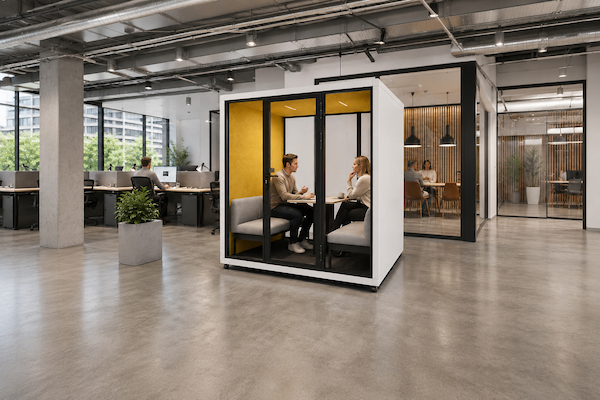
Speech Privacy, Not Total Silence
Office pods are often searched as “soundproof office pods” or “soundproof phone booths,” but the safer and more accurate project language is speech privacy support.
Speech privacy means helping users move conversations away from open desks into a more private and controlled space. For open-plan layouts, review office phone booths for open offices before planning booth placement. It is useful for phone calls, video meetings, HR talks, one-on-one conversations, and small discussions where speech exposure is a concern. If video meetings are the main use case, review office pods for video conferencing.
Safer Wording for Soundproof Searches
| Buyer / Search Wording | Safer Page Wording |
|---|---|
| soundproof office pod | acoustic office pod with speech privacy support |
| soundproof phone booth | office phone booth with tested acoustic evidence |
| soundproof meeting pod | meeting pod with acoustic performance explained under tested conditions |
| fully soundproof | Do not use as a product claim |
| absolute silence | Do not use as a product claim |
| 100% soundproof | Do not use as a product claim |
If you are comparing “soundproof” office pods, focus on speech privacy, tested acoustic evidence, and the conditions behind each report.
What Acoustic Evidence Can and Cannot Prove
Acoustic evidence helps buyers understand how a tested office pod configuration performs under defined test conditions. It can support speech privacy discussions, project review, and dealer or contractor communication.
It should not be used as a general promise for every model, configuration, glass option, or custom project.
Acoustic evidence should always be read with its tested sample, tested configuration, test standard, report number, and publication boundary.
Dsa / NIC / ISO / ASTM Explanation
Acoustic Values Should Be Read with Their Test Reports
Dsa and NIC are acoustic evidence terms, but they are not the same measurement. They come from different test standards and should be read with the related report, tested sample, tested configuration, and report boundary.
These reports give buyers a clearer way to understand acoustic performance under tested conditions. For a different model, glass option, layout, custom project, or special acoustic target, request an acoustic review before using the values in project documents.
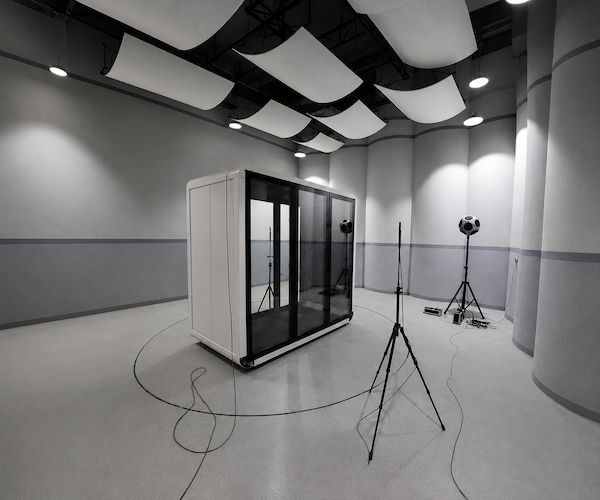
The acoustic values below are report-based evidence values and should be read together with the related test standard, report number, tested sample, and configuration boundary.
| Evidence Item | Current Value | Test Standard | Report No. | Safe Use Boundary |
|---|---|---|---|---|
| Dsa Acoustic Test Report | Dsa = 31.4 dB | ISO 23351-1:2020(E) | No. SDHL2303004062FT | Use with the tested sample, tested configuration, and report boundary |
| NIC Acoustic Test Report | NIC = 33 dB | ASTM E596-96 | No. SDHL2303004061FT | Use with the tested sample, tested configuration, and report boundary |
Customer-facing use should follow the approved publication or request boundary.
Acoustic Design Logic: More Than One Material
Speech Privacy Comes from the Whole Booth System
Speech privacy is not created by one material alone. It depends on how the booth body, glass, door system, sealing, ventilation path, installation, and test method work together. For model and capacity planning, use the capacity selection guide after reviewing the acoustic evidence boundary.
These design details help explain the booth system. Acoustic values should still be read from the related test report, not from one material or one structure detail alone.
Door Sealing and A4 Paper Check
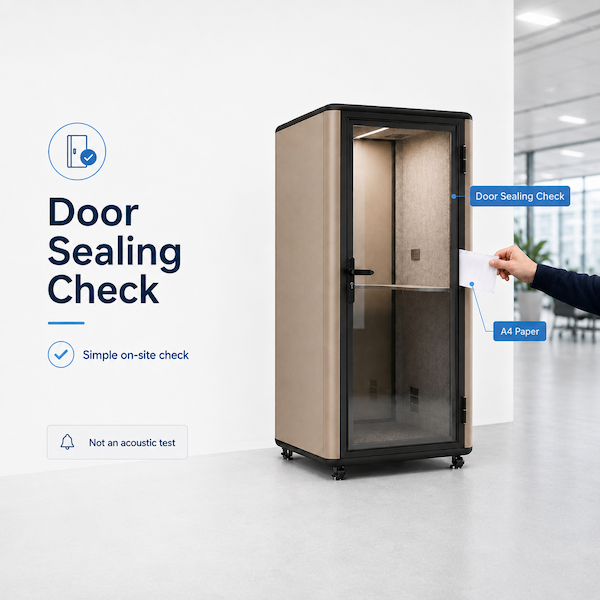
Door sealing can affect speech privacy because gaps around the door may create leakage points.
An A4 paper check can be used as a simple on-site reference for door contact and sealing condition after installation or adjustment. It is not an acoustic test and should not be used as proof of a specific dB value, Dsa result, NIC result, or SGS report result.
How to Read Acoustic Results in the Right Context
Acoustic Values Need Context
An acoustic value is useful only when buyers know how it was tested, which sample was tested, and how the result can be used.
For office pod projects, Dsa, NIC, test standards, report numbers, tested samples, and publication status should stay together. This helps buyers, dealers, contractors, and project teams use acoustic evidence correctly.
| Boundary Item | Why It Matters |
|---|---|
| Test standard | Dsa and NIC come from different test methods and should not be mixed together |
| Report number | Connects the value to a traceable evidence file |
| Tested sample | Shows which booth sample was tested |
| Tested configuration | Glass, acoustic layers, sealing, door system, ventilation path, and installation condition may affect performance |
| Publication status | Public text, public summary, public download files, and request-only files are not the same |
| Claim boundary | Prevents one result from being applied to all models, all configurations, or custom projects |
How to Use Acoustic Evidence in B2B Projects
Acoustic evidence helps buyers, dealers, contractors, and project teams discuss speech privacy with the right context before quotation, BOQ review, tender support, or customer presentation.
Who Uses the Evidence
Different project roles use acoustic evidence in different ways. The goal is not to make a broad soundproof promise, but to connect tested evidence with the project configuration and document use.
When to Request Acoustic Evidence
| Project Situation | Recommended Action |
|---|---|
| A buyer asks for soundproof performance, dB, Dsa, NIC, or report number | Request acoustic evidence or an approved report summary |
| A dealer needs material for customer communication | Use a clear evidence summary with claim boundaries |
| A contractor needs BOQ or tender support | Request project review before using acoustic values |
| The project has custom size, glass, layout, higher privacy expectations, or a special acoustic target | Confirm whether the tested evidence applies to the project condition |
| A buyer wants a full report or downloadable evidence file | Confirm whether the report can be shared directly or should be requested through the project team |
Demo videos can help buyers understand the booth experience. For acoustic values, request the related evidence or project review before preparing customer presentations, BOQ notes, or tender documents.
Request Office Pod Acoustic Evidence or Report Support
Choose the Right Evidence Route for Your Project
Different acoustic questions need different support materials. Some buyers only need an approved evidence summary before quotation, while others may need report information or a project acoustic review for BOQ, tender, or customer communication.
| Request Type | Use Case | Boundary |
|---|---|---|
| Request Acoustic Evidence | Buyer wants acoustic evidence before quotation | Use the approved summary or request route for the project |
| Request Dsa Report / Summary | Buyer asks about Dsa or ISO-based acoustic evidence | Use Dsa = 31.4 dB with ISO 23351-1:2020(E), Report No. SDHL2303004062FT, and the related report boundary |
| Request NIC Report / Summary | Buyer asks about NIC or ASTM-based acoustic evidence | Use NIC = 33 dB with ASTM E596-96, Report No. SDHL2303004061FT, and the related report boundary |
| Request Project Acoustic Review | Custom project, BOQ, tender, layout review, configuration comparison, special glass option, higher privacy expectation, specific test standard, or report wording before quotation | Review the model, configuration, glass option, layout, acoustic target, and project requirement together |
| Download Approved Report | Buyer needs a downloadable evidence file | Available only when a public version has been approved for download. Some full reports may need to be requested through the project team. |
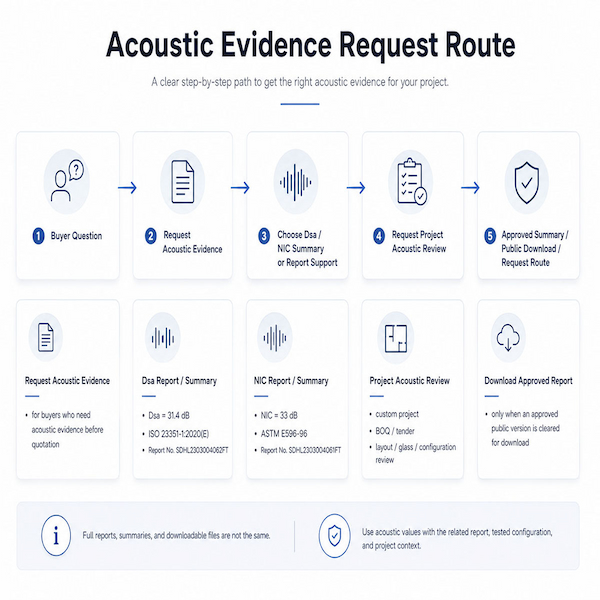
Full reports, summaries, downloadable files, and request-based files are not the same. Use Dsa = 31.4 dB or NIC = 33 dB only with the related test standard, report number, tested sample, tested configuration, and approved publication boundary.
Final FAQ and Safe Acoustic Claim Use
Final Questions Before Requesting Acoustic Evidence
What acoustic evidence is available?
ONMUSE acoustic evidence can include Dsa / NIC report information, approved report summaries, and project acoustic review support. The right evidence route depends on the buyer question and project use.
Do Dsa = 31.4 dB and NIC = 33 dB apply to every model and configuration?
No. Acoustic values should be read with the related test report, tested sample, tested configuration, test standard, and report boundary. A different model, glass option, layout, custom size, or higher privacy requirement may need project review.
Can an acoustic demonstration video replace the SGS report?
No. A demo video can help buyers understand the booth experience, but acoustic values should come from the related test evidence.
Does the A4 paper check prove acoustic performance?
No. The A4 paper check is only a simple door sealing reference. It does not prove Dsa, NIC, dB value, or SGS report performance.
Can buyers download the acoustic reports?
Some acoustic resources may be available as approved summaries, approved downloads, or request-based files depending on the public-version review status. Full reports, summaries, and request-based files are not the same. If a full report is needed, request the right evidence route before using acoustic values.
What does speech privacy mean for an office phone booth?
Speech privacy means giving users a more private place for calls, video meetings, HR talks, one-on-one conversations, and small discussions compared with speaking at an open desk. It helps reduce speech exposure, but it does not mean blocking every sound.
Are office pods soundproof?
Office pods should not be described as 100% soundproof or total-silence rooms. A safer explanation is that they support speech privacy and acoustic performance under tested and specified conditions.
Use Acoustic Evidence with Project Context
Acoustic evidence helps buyers understand speech privacy and tested performance. It should be reviewed together with the project model, configuration, glass option, layout, and document use.
For most projects, acoustic performance is best discussed through speech privacy support, tested acoustic evidence, acoustic performance under tested conditions, and project review when the configuration or document use changes.
If your team needs acoustic values for customer materials, BOQ notes, tender documents, or dealer presentations, request the related evidence or project review first.
A demo video, A4 paper check, material description, or supplier document can help explain the booth, but the acoustic value should come from the related acoustic report.
Plan Your Office Pod Project with the Right Resources
Use these resources when you need to compare pod options, request dimensions or spec sheets, review acoustic evidence, or prepare project quotation details.
Helpful Resources for Acoustic and Project Planning
Request Acoustic Evidence for Your Project
Share your model, configuration, glass option, layout condition, acoustic requirement, and document use case. The project team can help confirm the right evidence route before quotation, BOQ notes, tender documents, or dealer presentations.